


Almost every cell in your body runs on glucose. It’s the default fuel, the one we talk about, the one we measure.
The cells lining your colon are different.
Colonocytes, the epithelial cells that line the inside of your colon, lean on something else: butyrate. Its oxidation is estimated to supply 70% to 80% of their energy needs. These cells don’t get most of their fuel from your blood. They get it from what’s happening on the other side, inside the colon itself.
And what’s happening there is fermentation.
Where butyrate comes from
Butyrate is a short-chain fatty acid. You don’t make it, and you mostly don’t eat it. Your gut bacteria make it, by fermenting fibre.
The fibre you eat isn’t broken down in your stomach or small intestine. Your body doesn’t have the enzymes for most of it. So it travels on, intact, to the colon, where trillions of bacteria do have them. They ferment it, the way yeast ferments sugar in bread dough, and one of the things they produce is butyrate.
The colon cells take it up and burn it for energy.
(A small food engineering aside: butyrate gets its name from butter — butyrum, in Latin. Butyric acid is part of what gives butter, and especially butter that’s turned, its smell. Butter does contain a little. But nearly all the butyrate your colon uses is made on site, by bacteria.)
The part I find most elegant
Here’s what happens next, and it’s the reason I wanted to write this.
Burning butyrate uses oxygen. So when colon cells run on it, they draw oxygen out of the colon. That keeps the inside of the colon a low-oxygen environment.
And a low-oxygen environment is exactly what the beneficial bacteria need to grow. Many of them can’t survive with much oxygen around.
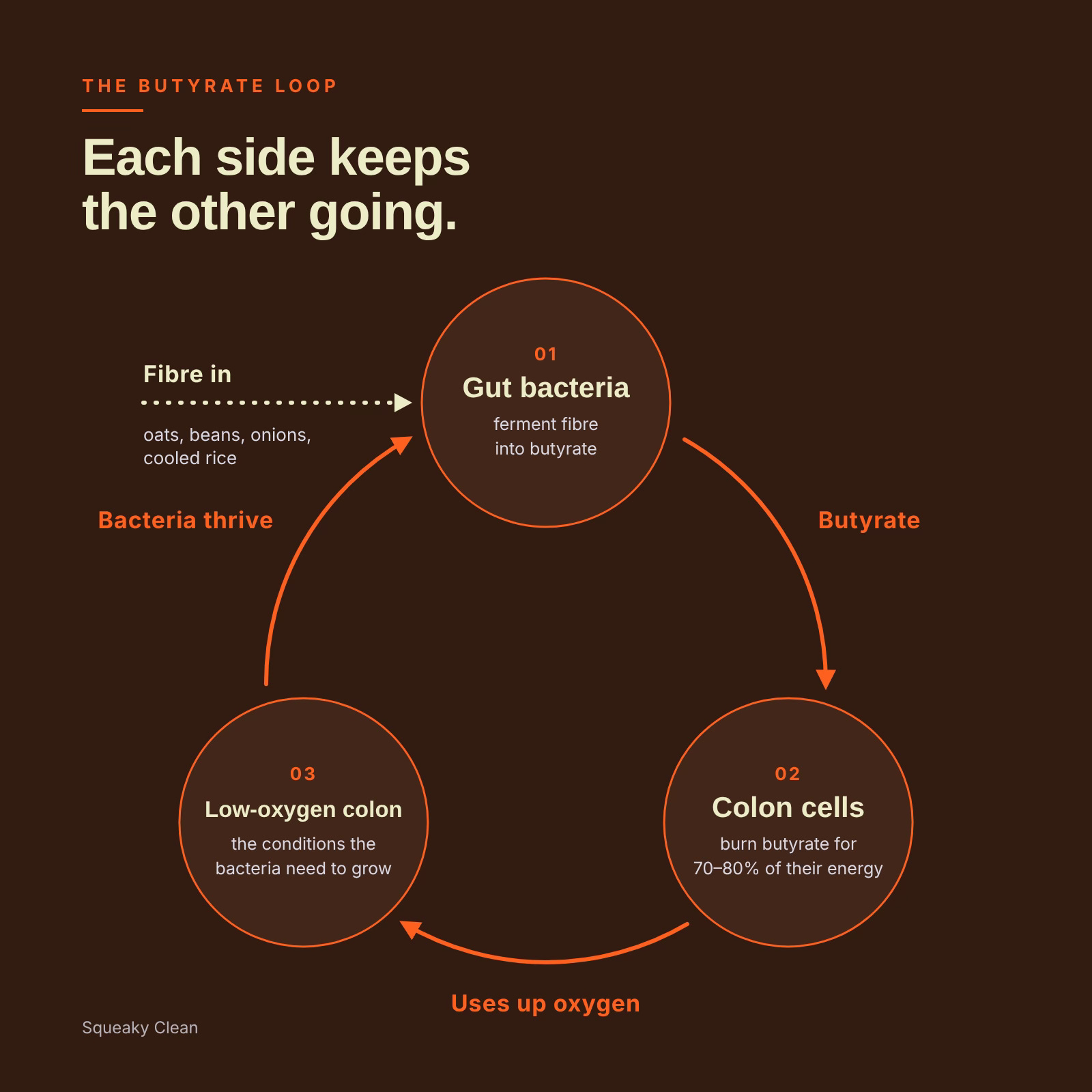
So it’s a loop. The bacteria ferment fibre into butyrate. The cells burn the butyrate, which pulls the oxygen down. Low oxygen keeps the conditions right for the bacteria that make butyrate. Each side keeps the other going.
What else it might do
This is where it gets more interesting, and where it’s worth being careful.
In animal models, butyrate has been associated with improvements in insulin sensitivity, glucose regulation, and body composition. Those results are why it gets so much attention.
Human trials remain less conclusive. People aren’t mice, and what happens in a controlled animal study doesn’t always carry over. It’s a promising area, not a settled one.
Fibre only helps if your gut can handle it
The obvious conclusion is: eat more fibre, make more butyrate. That’s true, with a catch.
Fibre raises butyrate production only when the gut can handle it. If your gut is already compromised, a sudden load of fibre can be too much, too fast. You get the discomfort without the benefit.
That’s why white rice and whole fruits (separately, not together) are suggested as a starting point for a compromised gut. They’re gentle and easy to tolerate, and they let you build from there instead of starting with the hardest things to digest.
The seed oil question
One more piece of research that’s worth knowing about.
In laboratory testing, excess linoleic acid, the main fat in most seed oils, impaired the growth of a beneficial gut bacterium. Seed oils — sunflower, soybean, corn, safflower — are in a huge share of packaged and restaurant food, so it’s easy to eat much more linoleic acid than you’d guess.
Practical ways to support butyrate production
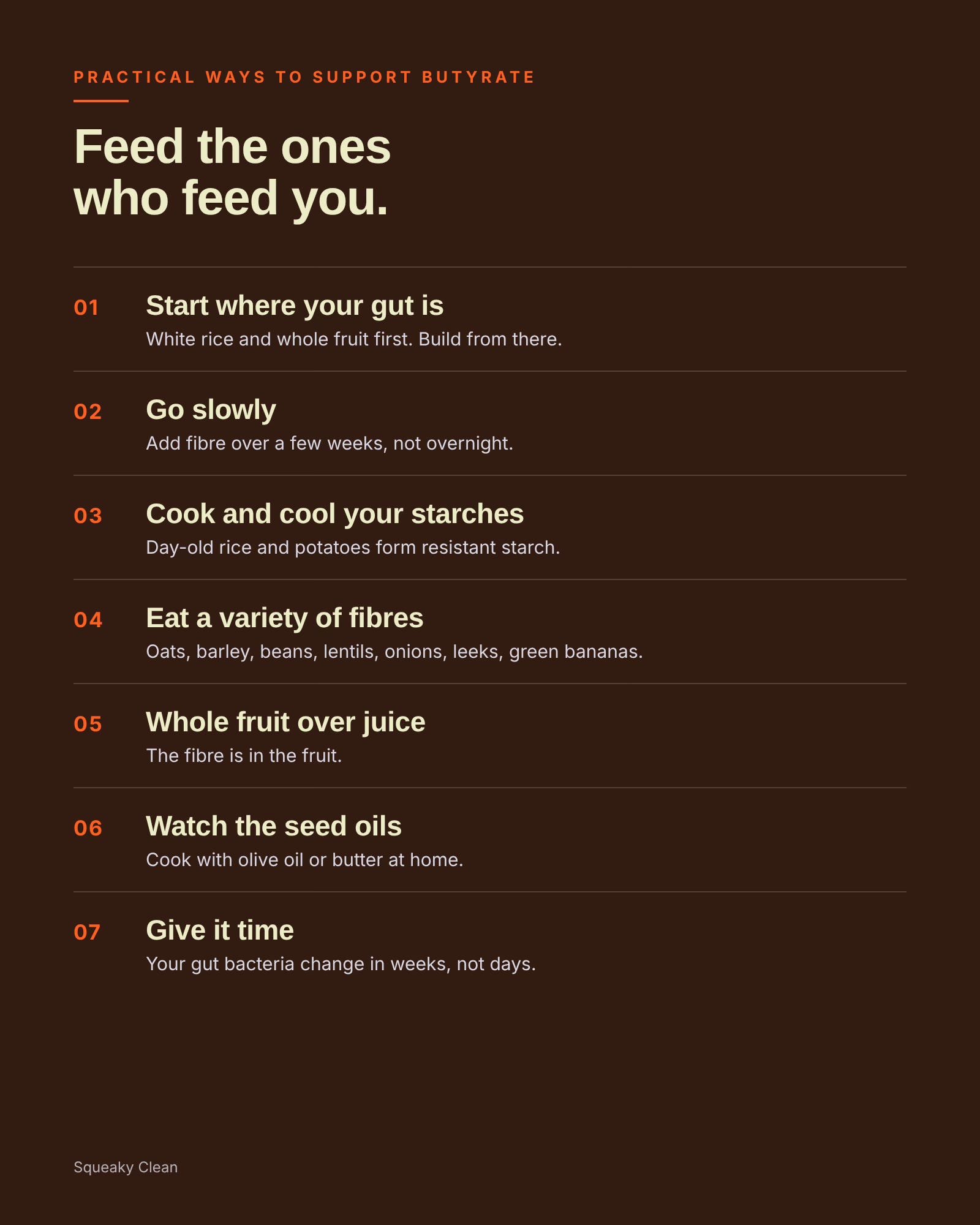
Start where your gut is. If things feel off, begin with gentle foods, like white rice and whole fruit, and build up. Don’t jump straight to a giant bowl of beans and raw kale.
Go slowly. Add fibre gradually over a few weeks, not overnight. Your gut bacteria need time to adjust to what you’re feeding them.
Cook and cool your starches. Rice and potatoes that are cooked and then cooled form resistant starch, a kind of starch that reaches the colon intact for the bacteria to ferment. White rice cooked the day before does double duty here: gentle on the gut, and a source of resistant starch. Keep it in the fridge and reheat it until it’s steaming.
Eat a variety of fibres. Different bacteria ferment different fibres. Oats and barley, lentils and beans, onions, leeks, garlic and asparagus, slightly green bananas. The wider the range, the more of your gut bacteria get fed.
Watch the seed oils. Cook with olive oil or butter at home, and notice how much of what you eat out or from packets is fried in or made with sunflower, soybean or corn oil.
Give it time. Your gut bacteria change with what you eat, but not in a day. Think in weeks.
Squeaky Clean is editorial and isn’t medical advice. If you have a digestive condition, or something has changed and isn’t settling, talk to a doctor before making big changes to your diet.